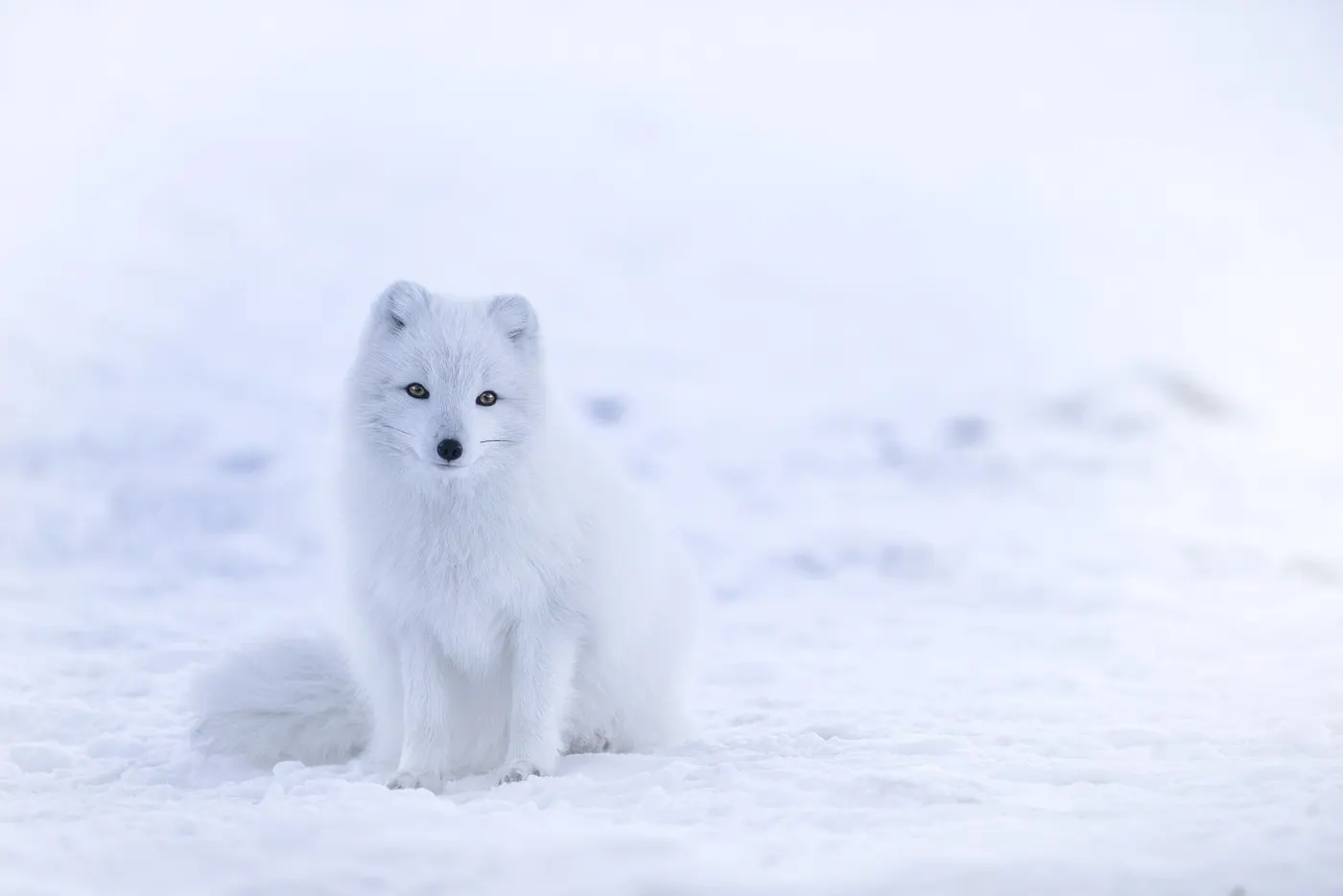
The Arctic Fox: Small Survivor of the Far North
The arctic fox is the kind of animal that makes you recalibrate what is possible. It weighs little more than a large house cat, yet it lives year-round in some of the harshest conditions on the planet, from the tundra coasts to the sea ice itself.
Built for the cold
Everything about the arctic fox is designed to conserve heat. It is compact and round, with short legs, small rounded ears and a short muzzle — all features that reduce the surface area through which warmth escapes. Its winter coat is the densest of any mammal, so effective that the fox does not even begin to shiver until the temperature drops below roughly −40 °C. Fur grows on the soles of its feet, insulating its pads and giving it grip on ice; the species' scientific name, Vulpes lagopus, means "hare-footed fox".
Then there is the famous colour change. The common form is sooty brown-grey in summer, blending with rock and vegetation, and turns pure white in winter for camouflage against snow. A rarer "blue" form stays a smoky slate-grey year round and is more common on coasts, where the background is dark rock and shoreline rather than snow.
A life ruled by lemmings
Inland, the arctic fox's fortunes are tied almost entirely to small rodents, especially lemmings, whose populations boom and crash on roughly three- to five-year cycles. In a good lemming year a single pair may raise an enormous litter — among the largest of any wild carnivore — and the tundra seems full of fox pups. In a crash year many dens stand empty.
This boom-and-bust forces a flexible diet. When rodents fail, coastal foxes turn to seabirds and their eggs, fish washed ashore, and carrion. On the sea ice they follow polar bears at a cautious distance, scavenging the remains of seal kills — a risky living, but a reliable one in the dark months when little else is available.
Journeys across the ice
Arctic foxes are astonishing travellers. Tracking studies have followed individuals walking across hundreds, even thousands, of kilometres of sea ice between landmasses in a single season, searching for food. For an animal this size, it is the equivalent of a continental crossing on foot.
Pressures and neighbours
The arctic fox is not everywhere secure. In parts of Scandinavia it was hunted so heavily for its fur that populations collapsed and have been slow to recover, helped now by conservation programmes. A subtler threat comes from the larger red fox, which is spreading north as the climate warms and willow and shrub creep up the tundra. Red foxes dominate at shared dens and can push the smaller species out of the best ground.
For all that, the arctic fox endures, curious and quick, trotting across the snow as if the cold were simply the weather it happens to prefer. Of all the animals of the tundra, it is the one I most like to find waiting, head tilted, at the edge of a camp.